By Grace Turner
High-resolution spectroscopy of the distant gas giant WASP-49b has uncovered a shifting, high-altitude cloud of neutral sodium gas that defies standard planetary atmosphere models. Astronomers analyzing the chemical signature report that the volatile vapor closely matches the output of a hyper-volcanic rocky exomoon locked in extreme gravitational tug-of-war.
Anomalous Sodium and Potassium Signatures at WASP-49b
Located approximately 635 light-years from Earth in the constellation Lepus, WASP-49b is a hot, Saturn-mass exoplanet that completes a full orbit around its yellow dwarf host star in just 2.8 days. Because both the planet and its star consist predominantly of lightweight hydrogen and helium gas, neither body should naturally eject massive quantities of heavy metallic vapors into high-altitude space. Yet spectroscopic transit observations revealed a dense plume of neutral sodium gas extending up to 1.5 planetary radii above the cloud tops.
Follow-up monitoring across multiple orbital transits showed that the sodium cloud behaves independently of the gas giant itself. At times, the sodium vapor moves at Doppler velocities reaching up to 100 kilometers per second away from the planet, moving counter to normal planetary rotation and atmospheric winds. The cloud also vanishes and reappears at irregular orbital phases while replenishing neutral sodium at astonishing rates approaching 100,000 kilograms per second.
Tidal Heating Mechanics and the Exo-Io Hypothesis
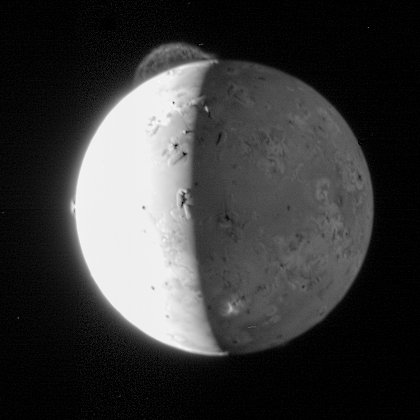
In our own solar system, a remarkably similar chemical environment surrounds Jupiter, where the innermost Galilean moon Io spews sulfur dioxide, sodium, and potassium into a sprawling plasma torus. Io is the most volcanically active body in the solar system because Jupiter’s immense gravity, combined with orbital resonances from neighboring moons Europa and Ganymede, continuously flexes its rocky interior. This relentless tidal kneading generates tremendous frictional heat that melts mantle rock and powers hundreds of persistent volcanic vents across its surface.
Applied to an extrasolar system, this mechanism becomes even more energetic when a rocky moon orbits a close-in giant planet like WASP-49b. Squeezed simultaneously by the nearby star and the host gas giant, an “exo-Io” experiences tidal flexing strong enough to drive continuous global volcanism and magma oceans. As volcanic plumes blast sodium and potassium high above the satellite’s weak gravity, stellar radiation photoionizes and sweeps the escaping atoms into an extended cloud trailing along the moon’s orbit.
Orbital Stability and the Search for Extrasolar Moons
Detecting exomoons through conventional transit photometry has proven notoriously difficult because small satellites produce tiny, barely perceptible dips in starlight. However, volcanic gas plumes expand across an area comparable to the host planet, dramatically amplifying the transit signal in specific atomic absorption wavelengths like the optical sodium and potassium lines. Theoretical modeling confirms that despite orbiting close to its star, a compact rocky moon around a low-density Saturn-class world like WASP-49b can remain dynamically stable within its Hill sphere for billions of years.
Over astronomical timescales, intense tidal dissipation and rapid volcanic mass loss can gradually erode a satellite’s crust or cause its orbit to decay inward. If an exomoon spirals past its planet’s Roche limit, gravitational tidal forces will eventually shred the rocky body into a glowing ring of silicate debris and metallic vapor. Ongoing advances in astrophysics and exoplanet spectroscopy continue to refine these observations, turning chemical cloud tracking into a powerful tool for discovering rocky worlds beyond our solar system.