By Ava Bennett
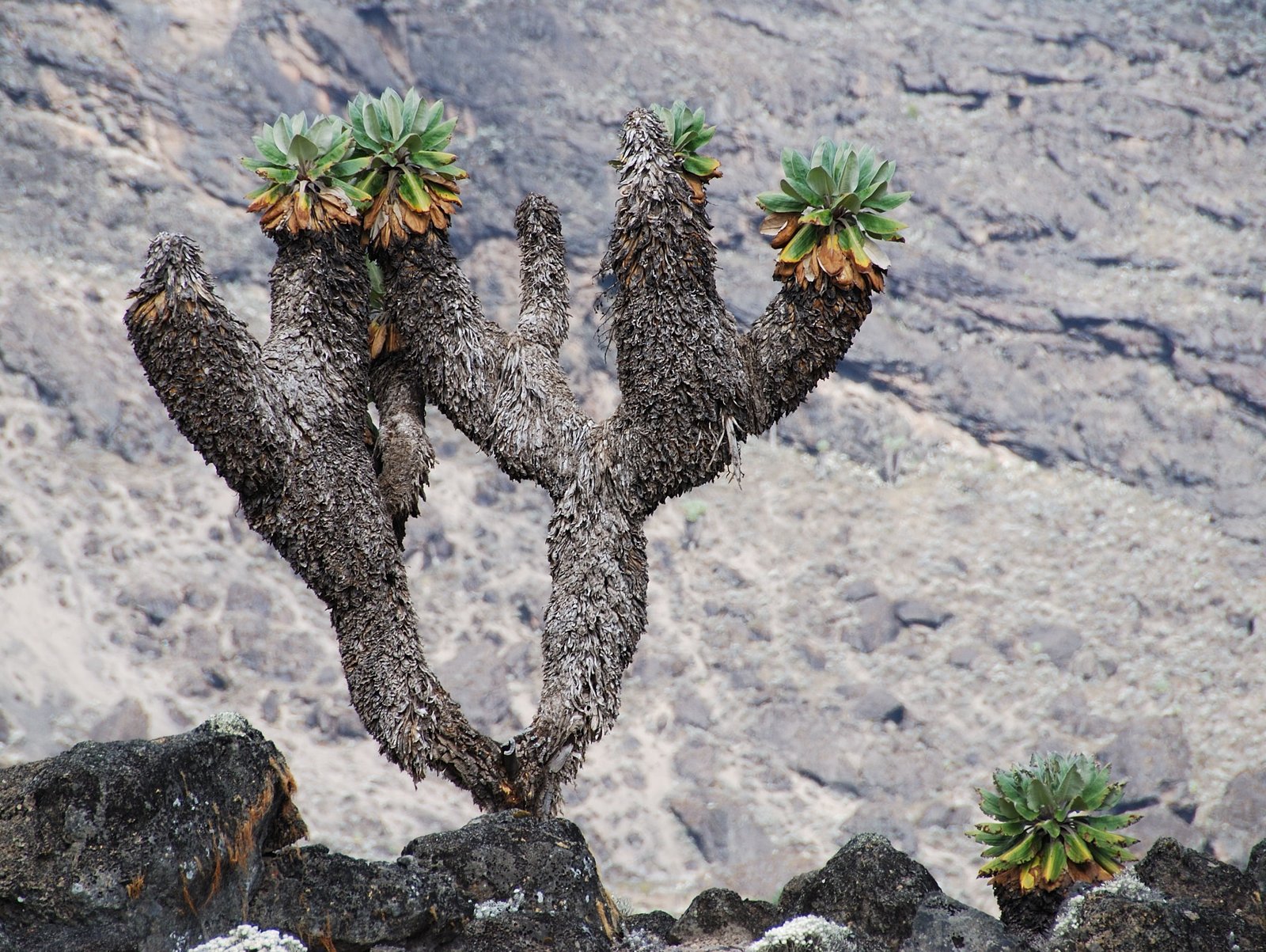
High on the volcanic slopes of Mount Kilimanjaro, an alien-looking forest of towering candelabra-shaped plants defies a climate of scorching equatorial days and freezing nights. Known as giant groundsels, these prehistoric-looking botanical marvels survive extreme temperature swings through nocturnal leaf folding, self-insulating trunks of dead foliage, and natural polysaccharide antifreeze fluids.
Conquering Summer Every Day and Winter Every Night
Although its common backyard relatives in the daisy family rarely grow taller than forty centimeters, Dendrosenecio kilimanjari reaches heights of up to nine meters across Kilimanjaro’s alpine zone. Thriving at elevations between 2,800 and 4,000 meters, the endemic species inhabits an equatorial mountain environment that ecologists describe as experiencing summer every day and winter every night. Intense tropical sunshine rapidly heats the thin mountain air by afternoon, only for radiative cooling to plunge nighttime temperatures as low as minus twenty degrees Celsius.
To protect its delicate growing tip from fatal frost damage, each branch terminates in a dense rosette of up to one hundred leathery leaves. As temperatures drop toward freezing at dusk, the plant performs a mechanical movement called nyctinasty, folding its outer leaves inward like a tightly closed cabbage bud. This nocturnal closure traps daytime heat around the central meristem and keeps internal bud temperatures several degrees warmer than the frigid mountain air.
At sunrise, the outer leaves unfurl again to capture solar energy for photosynthesis across the brief daylight window. Meanwhile, older leaves that wither and die do not drop to the ground; instead, they remain attached around the woody stem in a dense, fibrous layer up to thirty centimeters thick that insulates internal water-transporting pith.
Natural Polysaccharide Antifreeze and Evolutionary Gigantism
Beyond physical insulation, Dendrosenecio kilimanjari deploys an extraordinary biochemical defense by secreting up to a liter of viscous mucilage rich in complex polysaccharides and pectins. Pooled between the tightly packed young leaves of the crown rosette, this gelatinous fluid alters the way ice crystals nucleate when sub-zero cold penetrates the outer foliage. Rather than allowing sharp ice crystals to pierce living cell walls, the polysaccharide solution freezes only on its outer surface, forming an insulating ice cap that shields the liquid core beneath.
Genetic analyses in evolutionary plant science reveal that East Africa’s giant groundsels descended from a single wind-blown groundsel ancestor that colonized Kilimanjaro roughly one million years ago. Isolated on high volcanic peaks that acted like sky islands, those humble herbaceous weeds underwent rapid evolutionary gigantism to store water in their central pith and outlast alpine droughts.
Ecological Sentinels of East Africa’s High Moorlands
Because giant groundsels grow only a few centimeters per year, towering specimens with multiple candelabra branches are often more than a century old. Their water-storing trunks and sheltered leaf crowns create crucial microhabitats for high-altitude sunbirds, insects, and small mammals across otherwise barren volcanic valleys. Monitoring these slow-growing giants now helps ecologists track shifting cloud belts and wildfire patterns on Africa’s highest peak.
Botanists have also observed that branching occurs only after a giant groundsel produces a massive terminal flower spike containing thousands of yellow florets. Once seed dispersal concludes, the central flowering apex dies back and stimulates two to four lateral buds to sprout, creating the unmistakable forked silhouette seen along the Barranco Valley. Preserving this high-altitude flora remains vital for stabilizing volcanic soils and retaining mist moisture across Kilimanjaro’s upper watersheds.