By Sophia Reed
Towering like a glowing golden pagoda across windswept Himalayan ridges, the Sikkim rhubarb thrives in an unforgiving alpine zone where few vascular plants can survive. Botanists studying this remarkable giant herb have detailed how its translucent thermal bracts and patient multi-decade life cycle conquer freezing altitudes while debunking viral folklore about its blooming schedule.
Natural Glasshouse Architecture Between 4,000 and 4,800 Meters
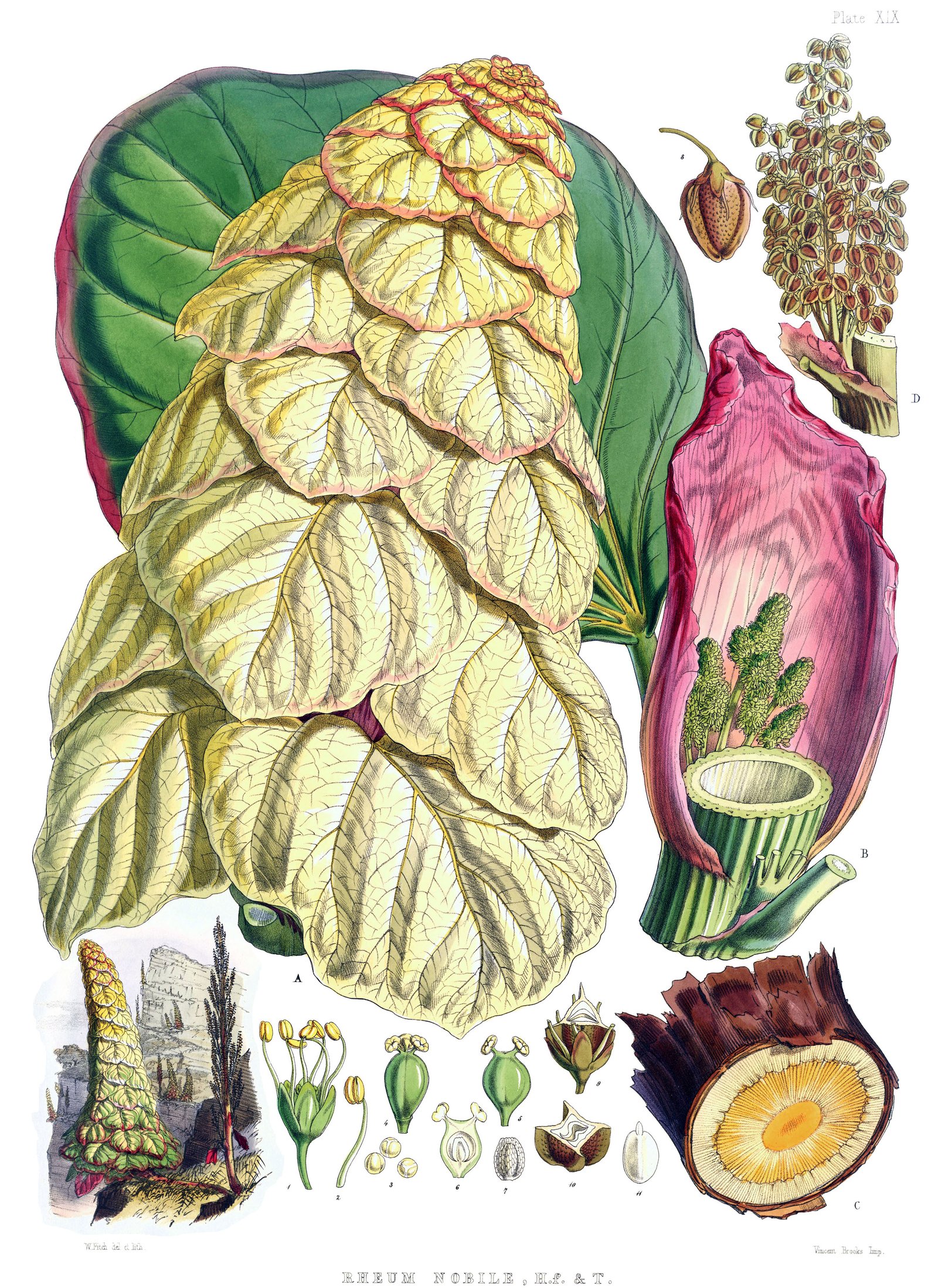
Known scientifically as Rheum nobile, the Himalayan giant rhubarb inhabits exposed scree slopes and glacial valleys across Nepal, Bhutan, Tibet, and northeastern India at elevations between 4,000 and 4,800 meters. At these extreme heights, intense solar radiation, sub-zero night frosts, and desiccating winds threaten delicate reproductive tissues during the brief summer growing season. To endure such hostility, the plant constructs a conical spire up to two meters tall composed of overlapping, paper-thin modified leaves called bracts.
These pale yellow and pink-edged bracts function as a selective optical filter that has earned the species its classification as a natural glasshouse plant. Physiological measurements demonstrate that the translucent membranes allow warming visible sunlight to penetrate into the hollow core while absorbing and reflecting destructive ultraviolet-B radiation. Inside the leafy cone, daytime temperatures can rise more than ten degrees Celsius above the surrounding alpine air, protecting developing pollen from chromosomal damage and thermal shock.
This warm microclimate also plays a vital ecological role by attracting fungus gnats that serve as the plant’s primary pollinators. Female gnats seek shelter inside the heated bract chamber to escape freezing mountain winds, pollinating the tiny green blossoms while laying eggs among the developing seeds.
A Monocarpic Life Cycle Decades in the Making
Unlike perennial shrubs that blossom every spring, Rheum nobile follows a strictly monocarpic reproductive strategy in which an individual plant flowers only once before dying. For seven to thirty years, the organism remains a low, unassuming rosette of thick basal leaves pressed tightly against the rocky ground. During this prolonged juvenile phase, it slowly accumulates carbohydrates inside a massive woody taproot while waiting for sufficient energy reserves to fuel its single reproductive burst.
When the stored energy threshold is finally reached, the plant rapidly sends up its towering inflorescence, disperses thousands of winged seeds into the autumn wind, and perishes completely. Researchers in botanical science emphasize that while each individual rosette takes up to three decades to mature, overlapping generations ensure that hundreds of plants bloom across the Himalayas every summer.
Debunking the Viral 400-Year Pagoda Flower Myth
Because the luminous spires appear so otherworldly against barren mountain rock, photographs of Rheum nobile have repeatedly circulated online accompanied by fabricated claims. Viral social media posts frequently misidentify the species as a mythical Mahameru or pagoda flower that supposedly blooms only once every four hundred years. Taxonomists confirm that this four-century interval is entirely fictional, noting that the species flowers annually across its native alpine range whenever mature rosettes complete their seven-to-thirty-year growth cycle.
Understanding the true biology of Sikkim rhubarb is increasingly urgent as warming mountain temperatures and unregulated livestock grazing pressure fragile Himalayan habitats. In several high-altitude valleys, premature harvesting of the plant’s tart stems and medicinal roots destroys juvenile rosettes before they can complete their decades-long maturation. Protecting intact alpine meadows ensures that these natural glasshouse towers continue to illuminate the roof of the world every monsoon season.