By Grace Turner
Surviving in the scorching interior of Western Australia requires extraordinary physiological ingenuity when standing pools of fresh water are virtually nonexistent. The thorny devil lizard has mastered this arid challenge through a specialized cutaneous plumbing network that pulls trace moisture from damp desert sand and channels it against gravity straight to its mouth.
Microscopic Capillary Grooves Beneath Armor-Like Spines
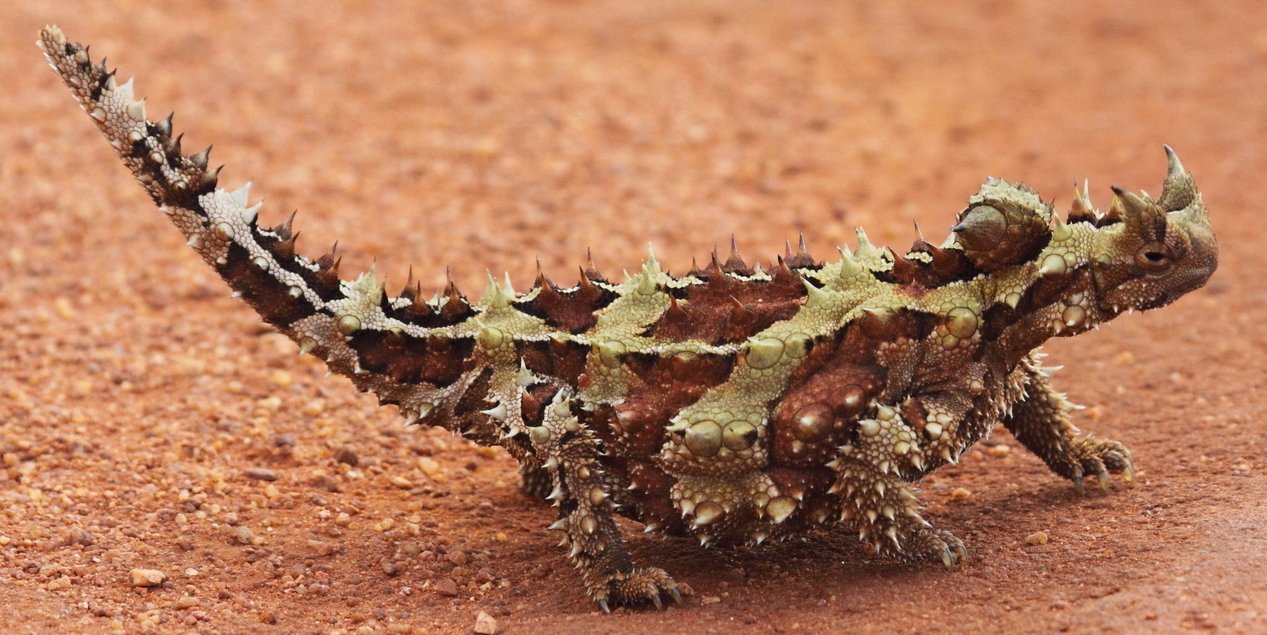
At first glance, the thorny devil, known taxonomically as Moloch horridus, appears engineered solely for defense against desert predators. Its mottled brown and tan body bristles with sharp, conical scales that deter birds of prey and goannas while providing camouflage across sun-baked dunes. Beneath this intimidating armor, however, lies an intricate hydraulic system composed of interconnected microscopic grooves running between the overlapping keratin scales.
High-resolution scanning electron microscopy reveals that these outer surface grooves lead into even narrower sub-scale channels lined with a honeycomb-like micro-ornamentation. When the lizard contacts morning dew, rare rainfall, or damp subterranean sand, the hydrophilic skin surface immediately wets and draws water into the tiny conduits. Through passive capillary action, surface tension pulls the liquid rapidly through the entire interconnected network until it saturates the network of channels covering the reptile’s body.
Because the channel network functions like a continuous sheet of blotting paper, moisture absorbed on the feet, belly, or back flows seamlessly toward the head. Once the cutaneous system reaches sufficient saturation, specialized oral ducts at the corners of the jaws allow the lizard to pump the collected liquid into its mouth by rhythmically opening and closing its jaws.
Harvesting Moisture From Damp Sand in Arid Outback Dunes
Behavioral experiments demonstrate that standing in open puddles is rarely how Moloch horridus hydrates in the wild. Instead, when early morning humidity condenses on cool desert soil, the lizard uses its hind legs to kick damp sand onto its ridged back. The porous capillary grooves extract the thin films of water clinging to individual quartz grains, enabling the reptile to drink without ever encountering free-flowing water.
Laboratory measurements show that the skin channels can transport water over several centimeters within seconds, overcoming gravitational resistance as liquid climbs from the feet toward the head. This passive physical mechanism requires zero metabolic energy until the final swallowing motion, when muscular gulping creates slight negative pressure at the labial margins. Researchers in evolutionary science note that this adaptation lets the lizard focus its foraging time exclusively on eating thousands of small desert ants without searching for waterholes.
Inspiring Biomimetic Fog and Dew Collectors
The hydraulic efficiency of thorny devil skin has captured the attention of materials engineers designing passive water-harvesting surfaces for drought-stricken regions. By replicating the reptile’s hierarchical micro-grooves and hexadecagonal pit textures in synthetic polymers and laser-etched metals, engineers can accelerate condensation and directional fluid transport without mechanical pumps. These bio-inspired surfaces promise more efficient atmospheric dew condensers, self-lubricating industrial bearings, and microfluidic cooling systems.
Comparative studies with other arid-zone reptiles, including the Texas horned lizard and Horvath’s toad-headed agama, show that convergent evolution has produced remarkably similar cutaneous microchannels on separate continents. However, the Australian thorny devil exhibits the most refined sub-scale honeycomb architecture, capable of holding equivalent to more than three percent of its total body mass in surface water. Decoding the exact geometry of these keratin channels continues to reveal how microscopic surface physics can solve macroscopic survival challenges.