By Sophia Reed
Thermal infrared mapping from the Lunar Reconnaissance Orbiter has revealed two sharply contrasting microclimates beneath the harsh surface of the Moon. While permanently shadowed polar craters plunge to cryogenic temperatures that lock away ancient water ice, sheltered collapse pits near the lunar equator maintain a remarkably mild temperature hovering near 17 degrees Celsius.
Extreme Thermal Swings Across the Exposed Lunar Regolith
Because the Moon lacks a substantial atmosphere to distribute heat or block solar radiation, its exposed dusty surface experiences some of the most severe temperature swings in the solar system. A single lunar day-night cycle lasts roughly 29.5 Earth days, subjecting the surface to two full weeks of uninterrupted sunlight followed by two weeks of freezing darkness. Daytime equatorial temperatures climb to around 127 degrees Celsius, only to plummet below minus 173 degrees Celsius overnight.
To map these hostile thermal regimes in detail, the Diviner Lunar Radiometer Experiment aboard the Lunar Reconnaissance Orbiter has continuously scanned the lunar surface across multiple infrared wavelengths. By measuring emitted thermal radiation at high spatial resolution, planetary scientists have identified localized geological features that buffer or completely invert normal surface conditions. These thermal anomalies play a central role in planning long-duration human habitats and robotic resource extraction across the lunar landscape.
Cryogenic Polar Cold Traps Preserving Ancient Water Ice
Near the lunar north and south poles, the rotational axis of the Moon tilts by only 1.54 degrees relative to the ecliptic plane. As a result, sunlight skims horizontally across the polar horizon and never reaches the deep floors of high-latitude impact basins such as Shackleton, Shoemaker, and Haworth craters. Isolated from direct solar heating for billions of years, these permanently shadowed regions continuously radiate residual heat into deep space.
Diviner infrared measurements show that temperatures inside the coldest polar craters drop below minus 240 degrees Celsius, colder than the surface of Pluto. At these cryogenic levels, volatile molecules delivered by comets, water-rich asteroids, and solar wind interactions become immobilized on contact with the dusty regolith. Because thermal sublimation is virtually nonexistent at such low temperatures, these polar cold traps preserve substantial reservoirs of water ice that could supply drinking water, breathable oxygen, and hydrogen-oxygen rocket propellant for deep-space missions.
Thermally Stable Lunar Pits Hovering Near 17 Degrees Celsius
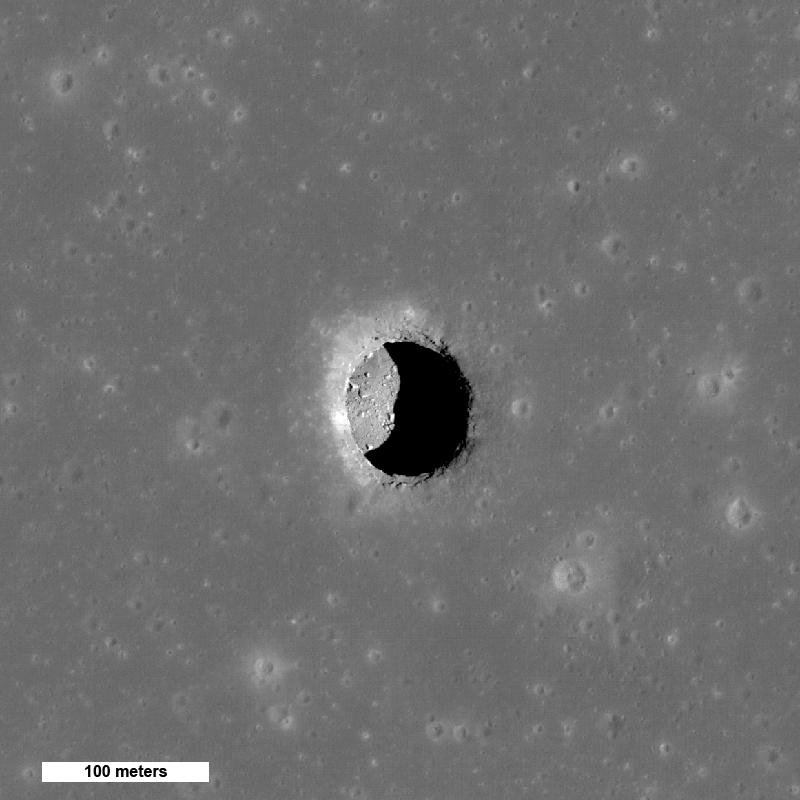
In stark contrast to the frozen poles, steep-walled collapse pits discovered across volcanic plains like Mare Tranquillitatis offer natural thermal havens. Formed when the ceilings of ancient underground lava tubes caved inward, the prominent Mare Tranquillitatis pit drops roughly 100 meters below the surrounding basaltic plain—about the length of a football field—and features overhanging rock walls that shade its recessed interior. Using three-dimensional computer models calibrated with Diviner thermal measurements, researchers calculated how heat radiates and conducts within the pit cavern over time.
Those models confirmed that the shadowed floor beneath the rock overhang stays comfortably near 17 degrees Celsius—about 63 degrees Fahrenheit—throughout the entire month-long lunar cycle, varying by less than a single degree. During the scorching lunar day, the overhanging ceiling blocks direct overhead sunlight, and during the frigid two-week night, the thick basaltic roof prevents stored heat from radiating away into space. Discoveries in planetary geology and space exploration suggest that if these pits open into intact subterranean lava tubes, astronauts could establish bases protected from micrometeorites, cosmic radiation, and brutal thermal extremes.