By Ava Bennett
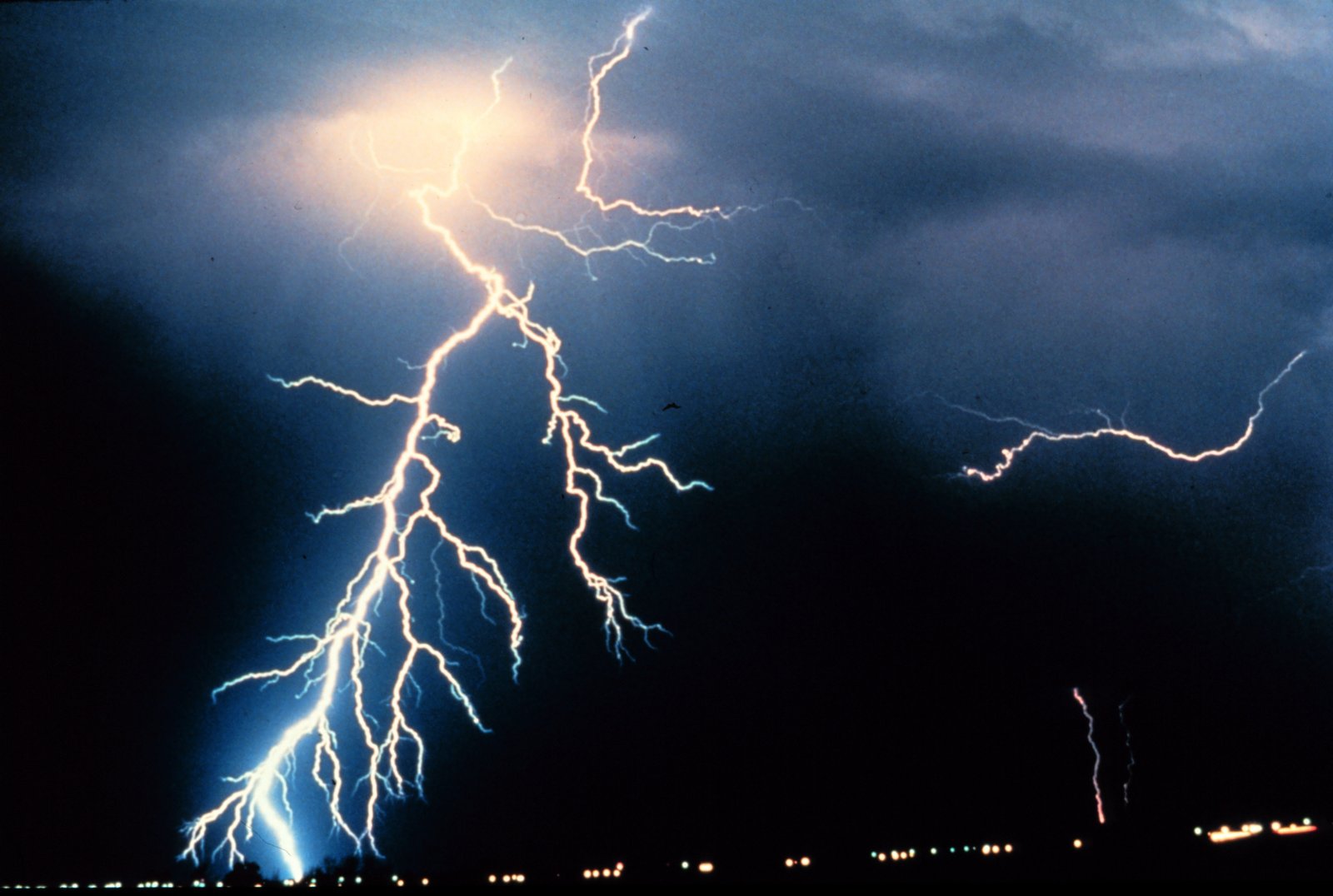
Towering cumulonimbus storm clouds operate as colossal electrostatic generators capable of unleashing millions of volts toward the surface in milliseconds. Driven by turbulent updrafts and microscopic ice collisions, cloud-to-ground lightning transforms insulating air into superheated plasma channels while generating the explosive acoustic shockwaves we hear as thunder.
Graupel-Ice Collisions and Charge Separation in Storm Clouds
Inside a mature thunderstorm, violent updrafts carry supercooled liquid water droplets, tiny ice crystals, and soft hail pellets known as graupel across freezing altitudes. As lighter ice crystals rise rapidly on warm air currents, they collide repeatedly with heavier, denser graupel pellets falling or suspended in the middle cloud layers. During these non-inductive collisions, negative electrons transfer onto the descending graupel while positive ions remain on the ascending ice crystals.
Gravity and vertical wind shear subsequently sort these charged particles across miles of vertical atmosphere. Positively charged ice crystals accumulate near the high anvil top of the cumulonimbus cloud, whereas negatively charged graupel settles into a dense mid-to-lower layer several kilometers above the ground. This strong negative cloud base repels electrons on the terrain below, inducing a concentrated shadow of positive charge across hilltops, trees, and tall structures.
Stepped Leaders and the 30,000 Kelvin Return Stroke
Air normally acts as a strong electrical insulator, preventing opposite charges from neutralizing effortlessly across open sky. Once the electric field between the lower cloud base and the ground exceeds the dielectric breakdown threshold of moist air, a preliminary pulse of electrons begins descending toward the surface. This invisible ionized channel, called a stepped leader, advances downward in jagged spurts roughly 45 meters long every few dozen microseconds.
As the branching stepped leader approaches within a few tens of meters of the surface, its intense negative potential draws upward-moving positive streamers from tall objects on the ground. When a rising positive streamer connects with one of the downward branches, a continuous conductive bridge snaps into place between cloud and earth. That completed circuit triggers the return stroke, a brilliant surge of current racing upward at nearly one-third the speed of light.
Although the electrical current flows rapidly along the ionized channel, human eyes perceive the event as an instantaneous flash descending from the sky. Within microseconds, peak currents reaching tens of thousands of amperes superheat the narrow conductive core to approximately 30,000 Kelvin, roughly five times hotter than the surface of the sun. If reserve charge pockets remain in the cloud, subsequent dart leaders can travel down the same channel to produce flickering multiple strokes.
Supersonic Expansion and Acoustic Shockwaves of Thunder
That sudden jump to 30,000 Kelvin leaves the air inside the lightning channel with no time to expand gently into the surrounding atmosphere. Heating the air in a fraction of a millisecond raises channel pressure to between ten and one hundred times normal atmospheric pressure. The compressed plasma cylinder explodes outward at supersonic speeds, piston-driving the surrounding air into a violent shockwave.
Within several meters of the discharge path, air resistance slows the supersonic shockwave into a high-amplitude acoustic wave that travels outward at the speed of sound. Close observers experience this rapid pressure spike as a sharp, deafening crack, whereas listeners miles away hear a prolonged, low-frequency rumble. Researchers studying atmospheric physics and planetary weather note that the rolling rumble occurs because sound waves from different altitudes along the tortuous, miles-long channel reach the ear at staggered intervals.