By Ava Bennett
More than 6,300 pounds of biomedical experiments, advanced materials hardware, and orbital power upgrades have arrived at the International Space Station following an October liftoff from Florida. The SpaceX CRS-35 commercial resupply flight delivered the final pair of roll-out solar wings alongside microgravity studies targeting human vision and neurological disease.
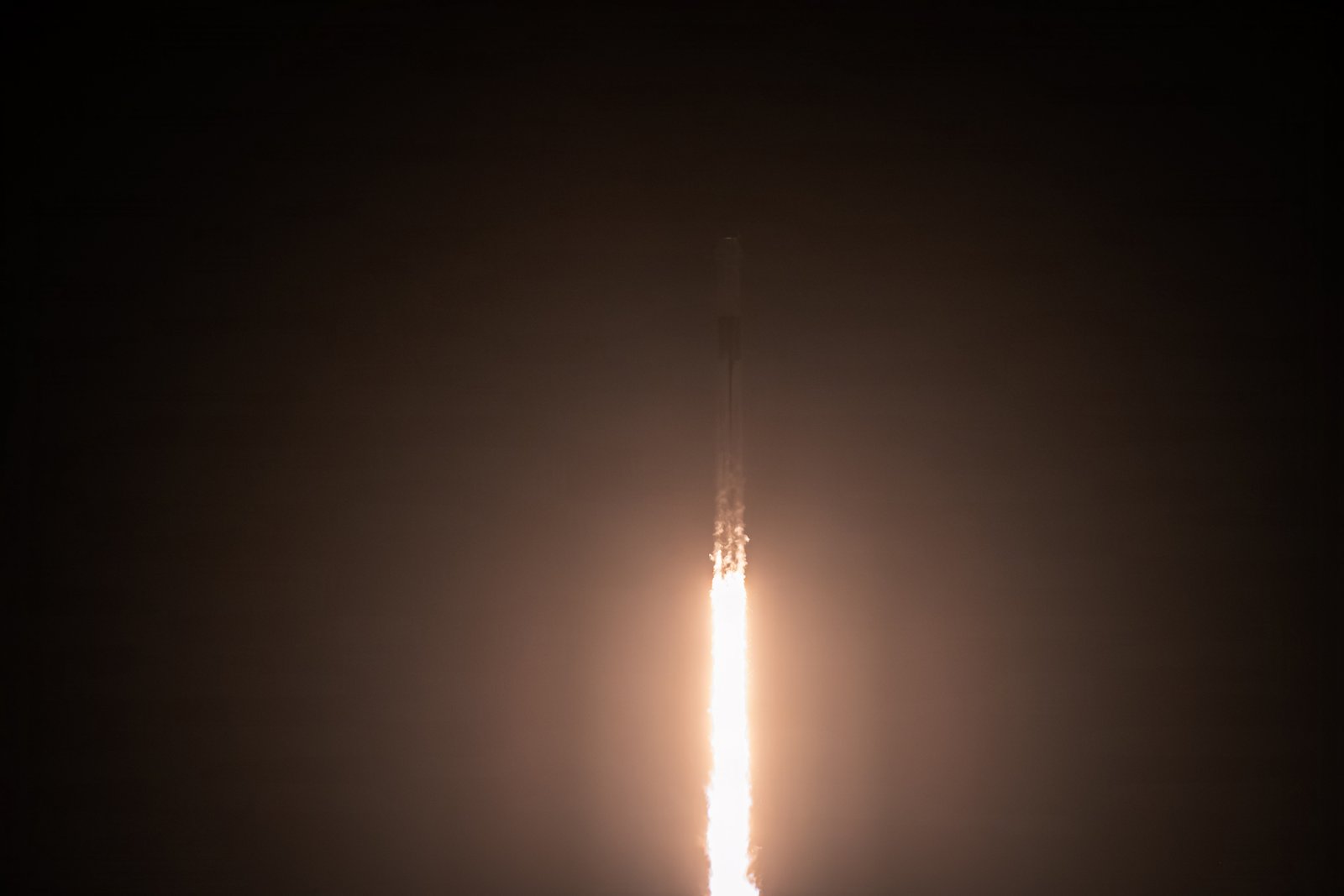
Lifting off at 6:33 a.m. EDT on Tuesday, October 13, 2026, atop a Falcon 9 rocket from Space Launch Complex 40 at Cape Canaveral Space Force Station in Florida, the autonomous Dragon cargo spacecraft completed a two-day orbital rendezvous. The capsule docked to the space-facing port of the station’s Harmony module at 11 a.m. EDT on Thursday, October 15.
Stowed inside the Dragon spacecraft’s unpressurized trunk was the final pair of International Space Station Roll-Out Solar Arrays. Scheduled for installation by spacewalking astronauts during autumn extravehicular activities, the compact panels unroll using stored kinetic energy to complete a multi-year augmentation of the orbiting laboratory’s electrical grid.
Completing the Orbital Laboratory Power Augmentation
Boosting the station’s electrical generation capacity provides essential power for hundreds of ongoing international research investigations, daily life-support operations, and the station’s eventual safe, controlled deorbit. The newly delivered roll-out arrays operate alongside the station’s legacy solar wings to maximize electricity production during each 90-minute orbit around Earth.
Inside the pressurized cargo cabin, the SpaceX CRS-35 mission transported dozens of new scientific payloads spanning biology, biotechnology, physical sciences, and Earth and space observation. Because microgravity removes buoyancy-driven convection and sedimentation, orbital researchers can cultivate delicate three-dimensional tissues and crystal structures that flatten or deform under terrestrial gravity.
Arrival of the resupply craft followed the October 1 launch of the Crew-13 expedition, whose four astronauts reached the Harmony module in a record seven hours and 50 minutes to join Expedition 75. Together, the expanded station crew is operating the newly delivered biomedical and materials racks throughout the autumn science cycle.
Artificial Retinas, Brain Organoids, and 3D Heart Tissue
Among the biomedical payloads is specialized fabrication hardware designed to manufacture thin-film artificial retinas in microgravity, an investigation aimed at restoring vision for patients on Earth affected by macular degeneration and retinitis pigmentosa. A companion study utilizes engineered three-dimensional heart tissue models to advance large-scale pharmaceutical testing and evaluate cardiac stress during long-duration spaceflight.
The cargo manifest also carries human brain organoids cultured in weightlessness to identify cellular mechanisms and potential treatment targets for neurodegenerative disorders such as Alzheimer’s disease, Parkinson’s disease, and multiple sclerosis. In parallel, materials researchers are testing how a new class of specialty glass forms in microgravity without gravity-induced structural defects.
Additional station experiments arriving this autumn examine stem cell-derived tissue engineering for personalized medicine, autonomous plant growth systems for fresh food production, and portable in-flight diagnostic devices that monitor astronaut blood flow. Each investigation is designed to protect crew health on deep-space voyages while improving clinical care in terrestrial hospitals.
Scheduled to remain attached to the Harmony module until mid-November 2026, the Dragon spacecraft will depart the station and splash down off the coast of California carrying time-critical biological samples. Breakthroughs from orbital Science continue to translate microgravity experiments into medical treatments on Earth while preparing crews for lunar and Martian exploration.