By Grace Turner
A rose-colored rock recovered from the Sahara Desert has been confirmed as one of the oldest planetary specimens ever discovered on Earth. Weighing nearly two pounds, the Martian meteorite Teghaza 001 crystallized more than 4.1 billion years ago, offering researchers an unprecedented record of early crust formation and subsurface liquid water.
Found on a salt plain in Mali in 2022, the 800-gram stone initially appeared to be a standard shergottite, the most common class of rocks ejected from Mars. Closer geochemical inspection among the roughly 435 known Martian meteorites revealed unusual textures and zircon crystals that set the specimen apart from nearly every other sample on Earth.
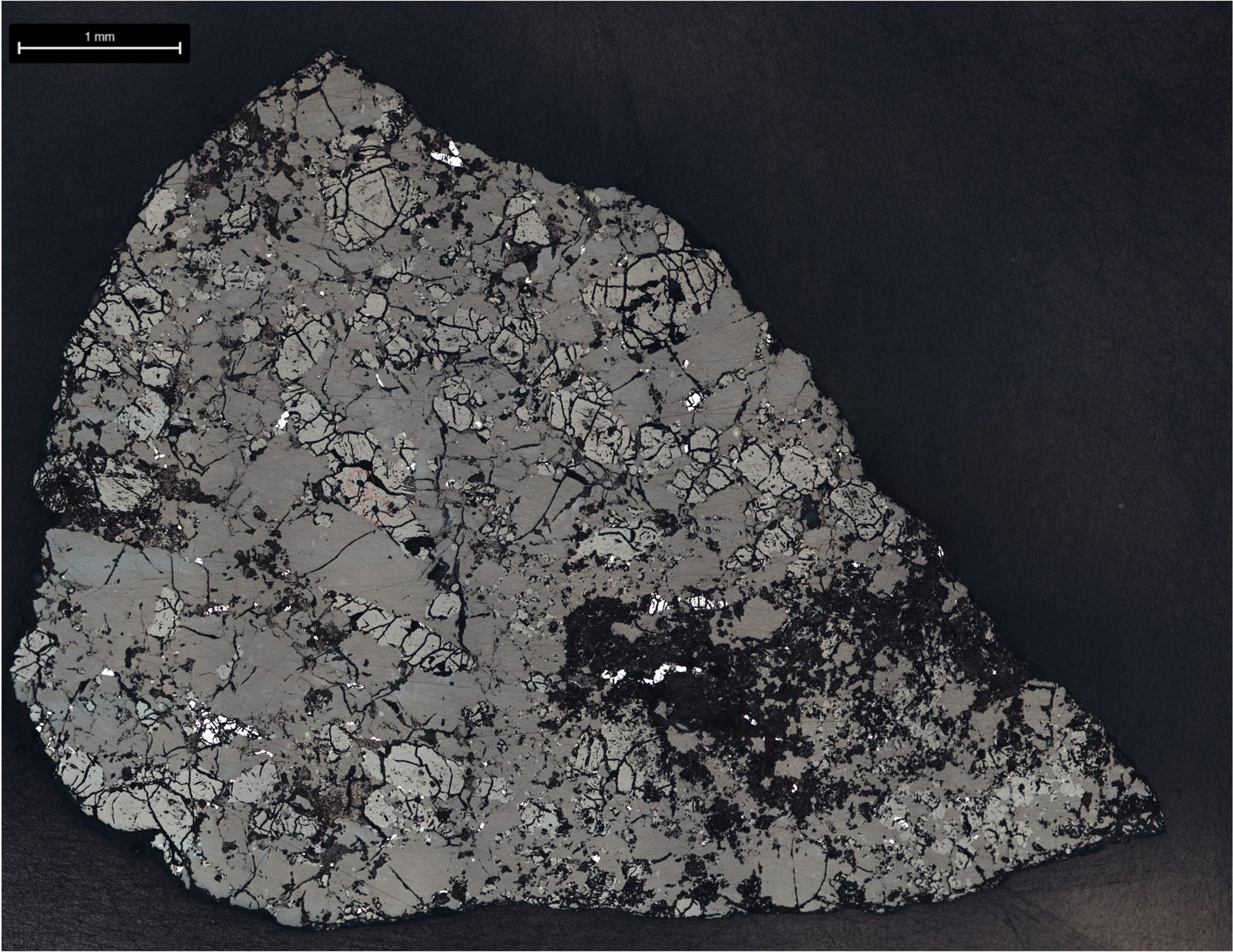
Published research in the journal Science led by planetary scientist Yang Liu at the Jet Propulsion Laboratory in Southern California characterizes the rock as a geological Rosetta Stone. Unlike previously studied ancient specimens, this sample preserves a diverse mixture of igneous minerals that crystallized directly from cooling magma before interacting with ancient groundwater.
A New Window Into the Cratered Southern Highlands
Only two other known rocks from the Red Planet approach this extreme age, and each offers a narrower view of planetary history. One famous counterpart, ALH84001, consists almost entirely of a single mineral type, while the fragmented rock nicknamed Black Beauty solidified roughly 2.1 billion years ago from mixed volcanic debris.
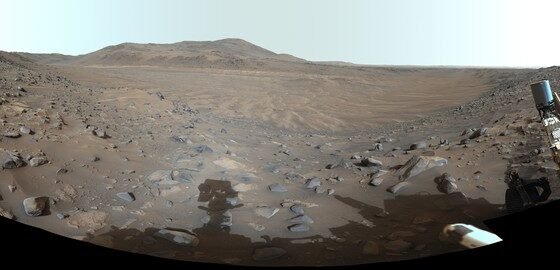
By contrast, the mineral chemistry of Martian meteorite Teghaza 001 aligns closely with orbital spectroscopy data from the Mars Reconnaissance Orbiter across the heavily cratered southern highlands. Co-author Lee Saper at the Ames Research Center in Silicon Valley noted that the rock represents the first direct crustal sample from a region never previously represented in laboratory collections.
Cross-referencing orbital elevation and spectral maps allowed geologists to narrow the rock’s likely launch sites to 13 candidate locations across the southern hemisphere. An ancient asteroid impact blasted the stone off the planetary surface, sending it on an interplanetary trajectory that eventually ended in the barren desert plains of West Africa.
Precision Age Dating and Ancient Water Alteration
Scientists at the University of New Mexico first verified the stone’s planetary origin by matching its oxygen isotope ratios to atmospheric and surface fingerprints measured by the Viking landers and the Curiosity and Perseverance rovers. Those isotopic signatures also hinted that the rock had experienced chemical exchanges with both liquid water and a thinning early atmosphere.
To establish an exact timeline without destroying the rare material, geochemist Francois Tissot at the California Institute of Technology applied a novel in-situ rubidium-strontium dating method. Rather than dissolving a bulk sample in acid, the team analyzed individual mineral grains on a surface fragment smaller than a human fingernail.
The high-precision measurements demonstrated that aqueous fluids altered the rock’s minerals approximately 4.1 billion years ago, meaning the original volcanic crust solidified even earlier. Companion findings published in Science Advances in June also quantified the specimen’s internal water content, pointing to an active hydrological cycle during the planet’s earliest epoch.
Ongoing breakthroughs in Science continue to reshape how researchers model rocky planet evolution across the solar system. Because the non-destructive dating technique preserves microscopic grain structures, laboratories worldwide can now conduct follow-up analyses on the exact same mineral surfaces to prepare for future sample-return missions from planets, moons, and asteroids.