By Maya Collins
After nearly 22 years of tracking the universe’s most energetic explosions, the Neil Gehrels Swift Observatory mission ends as atmospheric drag pulls the spacecraft below 171 miles above Earth. Mission controllers confirmed that the satellite completed its final scientific observation on October 20, 2026, ahead of its anticipated atmospheric re-entry in early November.
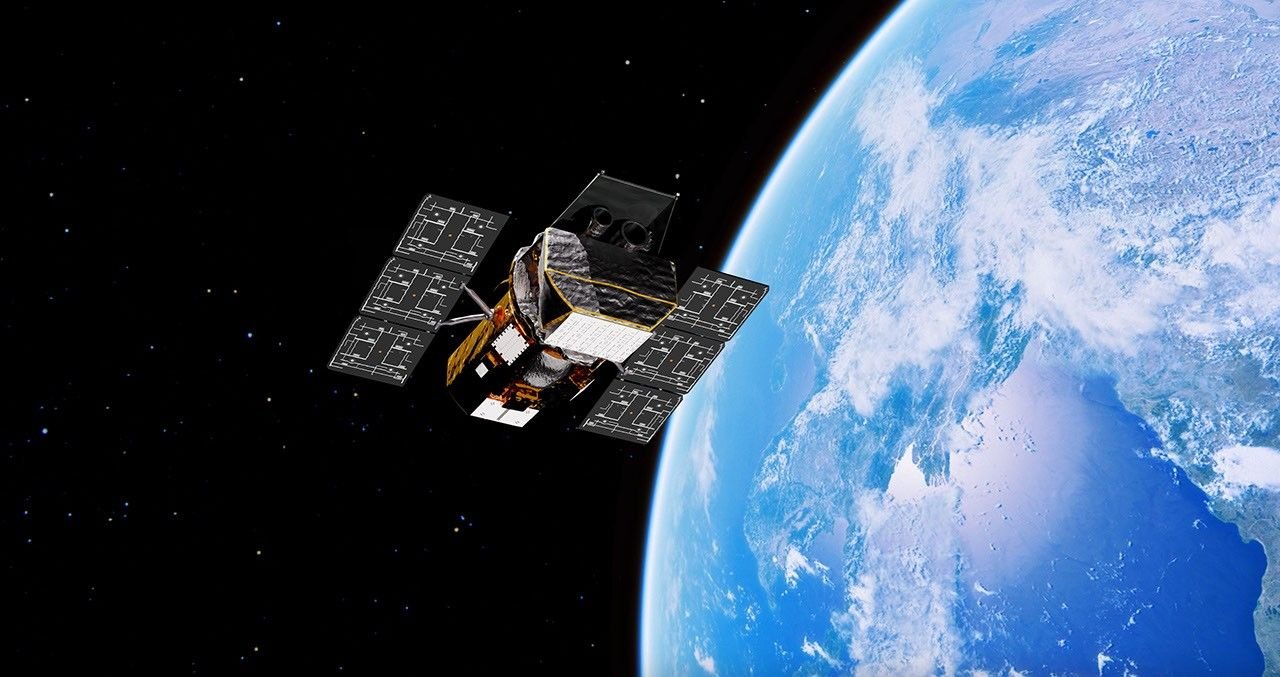
At altitudes below 275 kilometers, thickening atmospheric resistance prevents the spacecraft’s attitude control system from holding its telescopes steady on deep-space targets. Originally launched on November 20, 2004, for a two-year primary assignment, the multiwavelength observatory operated more than ten times longer than its baseline design life.
Shawn Domagal-Goldman, director of the Astrophysics Division in Washington, praised the spacecraft’s lasting scientific return and role in pioneering rapid-response time-domain astronomy. Named in 2018 to honor its late founding principal investigator Neil Gehrels, the satellite co-aligned X-ray, ultraviolet, and optical telescopes to catch fleeting cosmic flashes within seconds.
Solving the Mystery of Short Gamma-Ray Bursts
Before the observatory’s deployment, astronomers struggled to pinpoint gamma-ray bursts because the blasts faded before ground or orbital telescopes could slew to their coordinates. Principal investigator S. Bradley Cenko at the Goddard Space Flight Center in Greenbelt, Maryland, noted that the spacecraft autonomously detected bursts, broadcast coordinates, and pivoted its mirrors in roughly one minute.
That autonomous speed proved decisive in May 2005, when the satellite captured GRB 050509B, a short gamma-ray burst lasting just 0.03 seconds. By turning rapidly enough to record 11 X-ray photons from the fading afterglow, the mission confirmed theoretical predictions that short bursts originate from the violent collision of two city-sized neutron stars.
Over its nearly 22-year operational history, the spacecraft compiled an extensive scientific record:
- Observed more than 2,000 gamma-ray bursts and charted over 1,400 supernova explosions across distant galaxies.
- Scheduled up to 75 independent targets daily through a rapid target-of-opportunity command system managed with Penn State.
- Generated a public 12-terabyte archive containing 1.5 million ultraviolet and optical images and supporting approximately 7,000 scientific papers.
Preserving Rapid-Response Capabilities in Orbit
John Nousek, mission operations director and professor of astronomy and astrophysics at Penn State in University Park, Pennsylvania, credited the tight coordination between flight hardware and ground operations for making the satellite an all-purpose astronomical tool. Astronomers worldwide could submit target-of-opportunity requests that uploaded to the spacecraft in minutes.
Beyond gamma-ray bursts, the observatory witnessed stars torn apart by supermassive black holes, linked high-energy neutrinos to active galactic nuclei, conducted an all-sky X-ray survey, and monitored passing asteroids and comets. Every brightness measurement and multiwavelength spectrum has been curated into open public archives for ongoing research.
Even as the physical spacecraft prepares to burn up harmlessly in the upper atmosphere, astrophysicists continue mining its multiwavelength catalog to study gravitational-wave counterparts and transient stellar flares. To maintain rapid reaction times for cosmic explosions in a post-Swift era, space agency planners are coordinating existing orbital telescopes while evaluating agile commercial satellite platforms. As highlighted in our Top News science updates, the observatory’s 12-terabyte public dataset—equivalent to 600 high-definition movies—will fuel discoveries for decades.