By Noah Carter
Oceanographic engineers aboard the research vessel Okeanos Explorer departed Honolulu, Hawaii, at the end of October 2026 for an 18-day expedition testing next-generation NOAA autonomous underwater vehicles. Running through November 16, 2026, the EX2701 technology demonstration integrates untethered robotic submersibles into shipboard operations between the main Hawaiian Islands and remote Johnston Atoll.
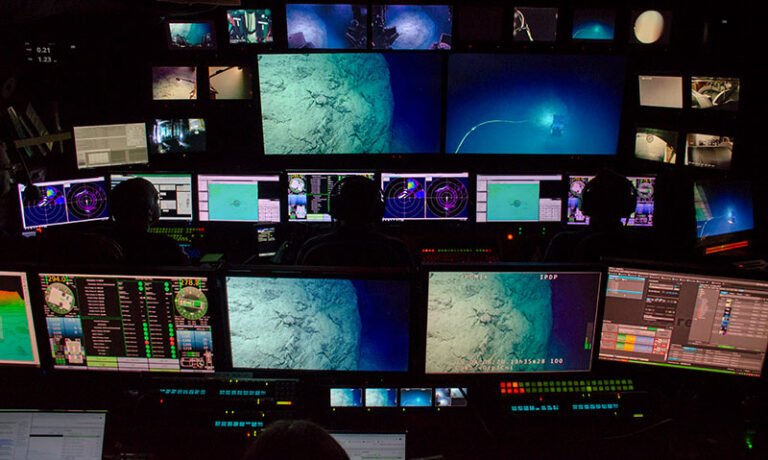
Organized in partnership with the Ocean Exploration Cooperative Institute, the mission evaluates how free-swimming robotic craft can bridge the scale gap between broad shipboard sonar sweeps and localized remotely operated vehicle dives. Insights from the Pacific trials will directly shape operational protocols for both Okeanos Explorer and its upcoming successor vessel, Discoverer.
Following a 48-hour equipment calibration and launch-and-recovery shakedown offshore Hawaii, the expedition is conducting two days of transit mapping toward Johnston Atoll. Because the operating zone overlaps deep-ocean regions of interest for marine critical minerals, high-resolution bathymetric and geological datasets will support responsible federal seabed resource management.
Deploying HUGIN 6000 and Compact Orpheus Submersibles
For the first time on Okeanos Explorer, crews are operating two complementary classes of untethered robotic vehicles rated to dive up to 6,000 meters (3.7 miles) beneath the ocean surface. Unlike tethered submersibles that require heavy fiber-optic cables connected to the surface ship, these programmable vehicles navigate preplanned seafloor corridors independently.
The largest robotic unit aboard the ship is the HUGIN 6000, an orange cylindrical vehicle capable of remaining submerged for up to 48 hours per dive. Alongside it, engineers from Orpheus Ocean are operating a pair of lightweight, compact Orpheus vehicles designed for close-range benthic imaging and physical sediment extraction.
Each robotic platform carries specialized scientific instrumentation tailored for deep-ocean characterization:
- The HUGIN 6000 deploys multibeam sonar, synthetic aperture sonar, a sub-bottom profiler, a magnetometer, and conductivity-temperature-depth sensors along tracklines up to 150 kilometers (93 miles) long.
- Two Orpheus vehicles carry high-definition cameras to build detailed seafloor photomosaics over targeted geological features.
- Custom pushcore mechanisms mounted on the Orpheus units will attempt to extract seabed sediment cores at depths of 5,000 meters (3.1 miles)—the deepest pushcore sampling ever attempted by the platform.
Advancing National Seabed Mapping and Mineral Science
Integrating multiple robotic platforms into a single expedition requires close coordination among shipboard engineers, oceanographers, and graduate researchers from partner institutions including the University of Rhode Island, the Massachusetts Institute of Technology, and Woods Hole Oceanographic Institution. Flexible payload configurations allow technicians to swap sensors between dives depending on seafloor terrain.
If the 5,000-meter sediment coring trials succeed, recovered seabed samples will be transferred to laboratories at the United States Geological Survey and the National Centers for Coastal Ocean Science for geochemical analysis. All sonar, magnetometer, and oceanographic measurements collected during the cruise will be released to the public Data Atlas within 120 days of mission completion.
Coordinated by expedition lead Philip L. Hoffman alongside university and industry specialists, the Pacific trials support the National Strategy for Mapping the United States Exclusive Economic Zone and the global Seabed 2030 initiative. Readers following marine technology in our Top News section can track how multi-vehicle ocean robotics are accelerating deep-sea discovery.