By Noah Carter
Measurements collected across 1,645 Martian days have revealed that microscopic particles clinging to spacesuit test fabrics on the Red Planet are far smaller than previously confirmed. This long-running Perseverance Mars dust study provides critical engineering and medical benchmarks to protect future human explorers from respiratory hazards and hardware wear.
Published on October 27, 2026, in the Proceedings of the National Academy of Sciences, the investigation examined five 20-millimeter squares of spacesuit fabric mounted on the robotic rover’s instrument calibration targets. Over nearly five Earth years of driving and core drilling in Jezero Crater, researchers tracked how airborne grains accumulated on Teflon, Vectran, and basaltic glass surfaces.
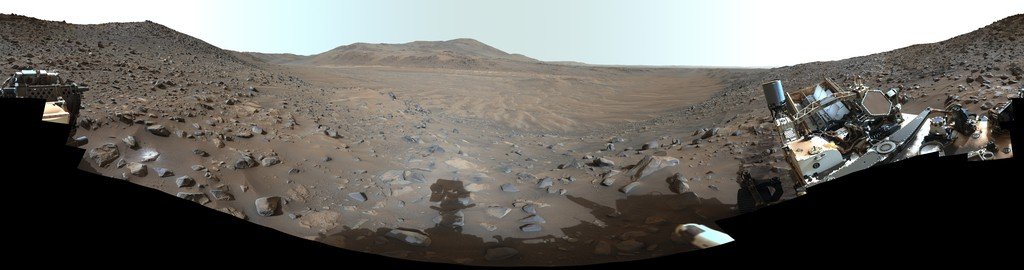
Surface exploration teams have contended with abrasive extraterrestrial regolith since the Apollo lunar landings, when jagged moon dust scratched helmet visors, degraded outer garment layers, damaged pressure seals, and triggered hay-fever symptoms inside crew modules. Although wind-rounded Martian grains are less jagged than lunar particles, regional and global dust storms keep them perpetually circulating through the atmosphere.
Measuring Fine and Ultrafine Particles on Spacesuit Swatches
Earlier planetary landers and rovers could only resolve airborne grains down to roughly 3 micrometers in diameter. By using the Planetary Instrument for X-ray Lithochemistry, or PIXL, alongside the SHERLOC Raman and luminescence spectrometer on the rover’s robotic arm, scientists isolated elemental X-ray signals coming directly from dust resting on element-free Teflon targets.
The Perseverance Mars dust study identified two distinct classes of microscopic hazards: fine particles measuring less than 2.5 micrometers and ultrafine grains ranging between 100 and 300 nanometers across. For comparison, an average strand of human hair is approximately 70 micrometers wide, making the smallest detected Martian grains roughly 700 times thinner.
Lead author Scott VanBommel at Washington University in St. Louis explained that while larger clumps of dust shake loose as the rover traverses rocky terrain, static electricity locks the tiniest particles onto outer garment polymers. Grains colliding in the dry Martian wind acquire electrical charges that bind stubbornly to woven Teflon and Vectran swatches.
Health Risks and Engineering Solutions for Future Habitats
Chemical analysis confirmed that the adhered particles are rich in silicate minerals, iron, chlorine, sulfur, phosphorus, and calcium sulfate. Crucially, Martian regolith also carries reactive iron compounds capable of inducing cellular damage and perchlorate salts known to disrupt human thyroid function depending on exposure duration and quantity.
In terrestrial medicine, airborne particulate matter smaller than 2.5 micrometers can penetrate deep into lung tissue and cross directly into the bloodstream. Ultrafine particles around 100 nanometers pose an even steeper physiological challenge, as clinical studies show they can migrate from the nasal cavity along the olfactory nerve to the brain.
Planetary Science Division acting director Lindsay Hays and project scientist Katie Stack Morgan at the Jet Propulsion Laboratory noted that these spacesuit measurements give flight surgeons and engineers empirical data well before astronauts arrive. To prevent dust from entering living quarters, designers are evaluating external suitports, dual-chamber airlocks, and protective coatings that shed charged grains.
Recent advances in planetary Science also include an Electrodynamic Dust Shield tested on the Moon in March 2025 aboard Blue Ghost Mission 1 and handheld electrostatic mitigation tools undergoing vacuum trials at Johnson Space Center in Houston.