By Noah Carter
Towering nearly as high as urban skyscrapers over coastal waters, 15-megawatt and 16-megawatt offshore wind turbines are redefining utility-scale clean electricity. Flagship machines such as the Vestas V236-15.0 MW and MingYang MySE 16-260 sweep vast expanses of ocean air, generating enough power from a single blade rotation to run a household for two days.
Swept Area Physics Drives Exponential Energy Yields
In wind turbine aerodynamics, energy capture scales exponentially with blade length because power output is directly proportional to the circular area swept by the rotor. Doubling the length of a turbine blade quadruples the total wind-harvesting zone without requiring four separate ocean foundations.
The Vestas V236-15.0 MW employs three 115.5-meter blades to achieve a 236-meter rotor diameter, creating a swept area of 43,742 square meters. A single unit can produce up to 80 gigawatt-hours of clean electricity annually, enough to supply roughly 20,000 European households.
Pushing scale even further, the MingYang MySE 16-260 stretches its rotor diameter to 260 meters across a 53,902-square-meter capture zone. Each complete turn of its massive hub generates roughly 34.2 kilowatt-hours of electricity while operating in deep-water marine wind corridors.
Carbon-Fiber Pultrusion And Modular Drivetrain Design
Constructing blades longer than a football field requires structural materials that resist gravitational sag and violent typhoon gusts without adding excessive mass. Manufacturers reinforce fiberglass shells with pultruded carbon-fiber spar caps that deliver superior stiffness-to-weight ratios across the airfoil.
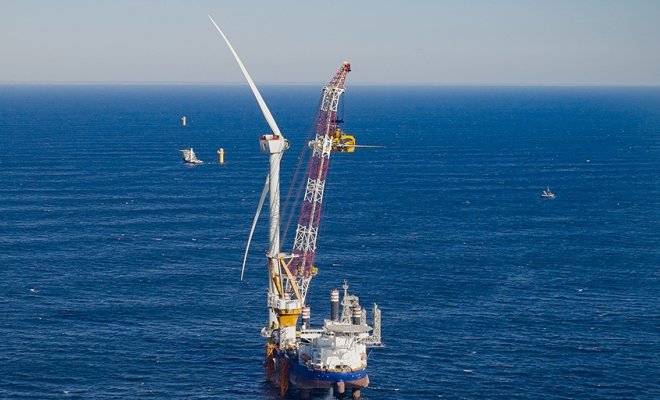
At the top of the tower, compact medium-speed geared drivetrains and permanent-magnet generators convert low-speed rotor torque into grid-ready alternating current. Modular nacelle compartments allow cranes and jack-up installation vessels to hoist sub-assemblies separately at sea.
Real-time pitch actuators and digital twin sensors continuously adjust each blade’s angle of attack based on incoming lidar wind measurements. This integration of renewable energy technology enables 16-megawatt platforms to survive extreme category-five storm surges while maximizing capacity factors above 60 percent.
Engineers have also developed recyclable epoxy resins that allow decommissioned composite blades to be chemically separated into reusable fibers at the end of their operational life. Anti-erosion leading-edge shields protect blade tips spinning at nearly 300 kilometers per hour from raindrop and sea-salt pitting.
Slashing Offshore Balance-Of-Plant Infrastructure Costs
For offshore wind farm developers, steel monopile foundations, subsea export cables, and specialized installation ship charters account for a massive share of project capital expenditure. Deploying 15-megawatt and 16-megawatt turbines significantly reduces the number of individual towers required to build a one-gigawatt power plant.
Fewer turbine positions translate directly into shorter array cabling trenches, faster marine construction schedules, and lower annual maintenance vessel trips. Commercial installations across the North Sea, the Baltic Sea, and the Taiwan Strait are already locking in lower levelized costs of electricity.
Semi-submersible floating foundations are also being paired with 16-megawatt nacelles to unlock deep-water wind resources beyond the reach of fixed seabed pilings. High-voltage direct-current offshore substations collect the multi-megawatt output and transmit it hundreds of kilometers inland with minimal line loss.
As port terminals expand crane capacities to handle 115-meter to 126-meter composite blades, ultra-large marine turbines are becoming the backbone of coastal grid decarbonization. By harvesting high-altitude ocean winds at multi-megawatt scale, these rotating giants deliver consistent baseload-like clean power.