By Ava Bennett
After nearly 22 years of tracking the most energetic explosions in the cosmos, a pioneering orbital telescope has reached the conclusion of its scientific journey. The roughly 3,200-pound Swift gamma-ray observatory is scheduled to re-enter Earth’s atmosphere on November 4, 2026, concluding more than two decades of rapid-response astrophysics.
Formally known as the Neil Gehrels Swift Observatory and managed from Goddard Space Flight Center in Greenbelt, Maryland, the satellite launched in 2004 for what engineers originally designed as a two-year prime mission. Over the subsequent 22 years, the spacecraft operated as a versatile cosmic sentinel, combining gamma-ray, X-ray, and ultraviolet-optical telescopes on a single platform.
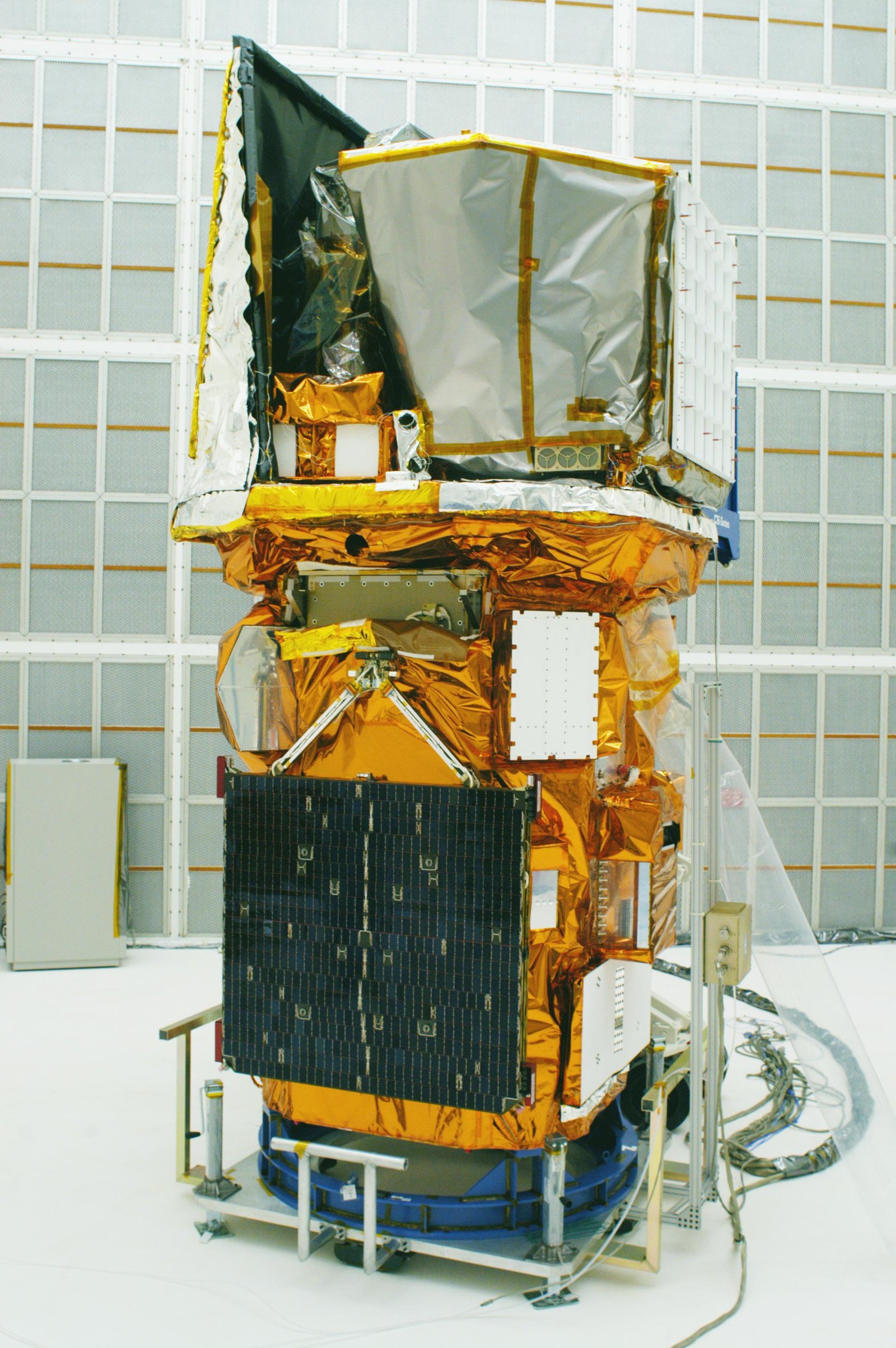
Mission controllers officially concluded science operations on October 23, 2026, as atmospheric drag steadily lowered the satellite’s orbital altitude. Updated tracking predictions from the U.S. Space Force placed atmospheric re-entry at approximately 3:30 a.m. EST on Wednesday, November 4, with an uncertainty window of 11 hours as the spacecraft makes its final orbits.
Atmospheric Re-Entry Dynamics and Equatorial Footprint
Because the observatory was built without an onboard propulsion system to execute a targeted deorbit burn, natural solar activity and upper-atmospheric density governed its gradual descent from low Earth orbit. Aerospace engineers expect intense aerodynamic heating to incinerate the vast majority of the 3,200-pound structure as it plunges through the upper atmosphere.
Although small heat-resistant hardware components are expected to survive re-entry, the satellite’s low orbital inclination restricts any potential debris footprint to a band between 20.6 degrees north latitude and 20.6 degrees south latitude. Orbital debris analysts calculated the likelihood of any surviving fragment causing harm to a person on Earth at approximately 1 in 2,100.
Depending on the exact hour of atmospheric breakup, any surviving fragments could fall across ocean basins or equatorial regions in either hemisphere. Space Force and civilian tracking stations continued refining trajectory models and issuing public status advisories throughout the final 48 hours of the satellite’s orbital decay.
Two Decades of Decoding Cosmic Explosions
At the time of its 2004 launch, astronomers struggled to pinpoint gamma-ray bursts because the initial high-energy flashes typically last only milliseconds to a few minutes. The Swift gamma-ray observatory solved that observational bottleneck by detecting bursts across a wide field of view and autonomously slewing its narrower X-ray and ultraviolet instruments toward the fading afterglow within seconds.
Within moments of each detection, the spacecraft broadcast precise sky coordinates to ground-based and space-based telescopes worldwide to coordinate follow-up campaigns. Those rapid alerts enabled astrophysicists to witness the birth of stellar-mass black holes, confirm how colliding neutron stars forge heavy elements, and measure light from exploding stars across the early universe.
In addition to capturing thousands of transient high-energy events, the spacecraft worked alongside flagship X-ray and optical observatories to map active galactic nuclei and track sudden magnetar outbursts. Its ultraviolet and X-ray sensors also measured hydroxyl gas production in passing comets, linking deep-space astrophysics with planetary research inside our solar system.
Beyond gamma-ray bursts, the observatory monitored active galaxies powered by supermassive black holes, stars undergoing violent X-ray flares, and supernova explosions. As highlighted across our Science coverage, the rich multiwavelength archive left behind by this 22-year mission will fuel astrophysical discoveries for decades.