By Daniel Hayes
A pair of refrigerator-sized probes is preparing to execute a high-speed orbital slingshot maneuver never before flown by a Mars-bound mission. On November 7 and November 9, 2026, the twin ESCAPADE spacecraft will combine terrestrial gravity with nine-minute engine burns to propel themselves toward the Red Planet.
Short for Escape and Plasma Acceleration and Dynamics Explorers, the mission pioneered an unconventional interplanetary trajectory after launching in November 2025. Traditional Mars missions must launch during narrow orbital alignment windows that occur only once every 26 months, when Earth and its neighboring world line up favorably on the same side of the Sun.
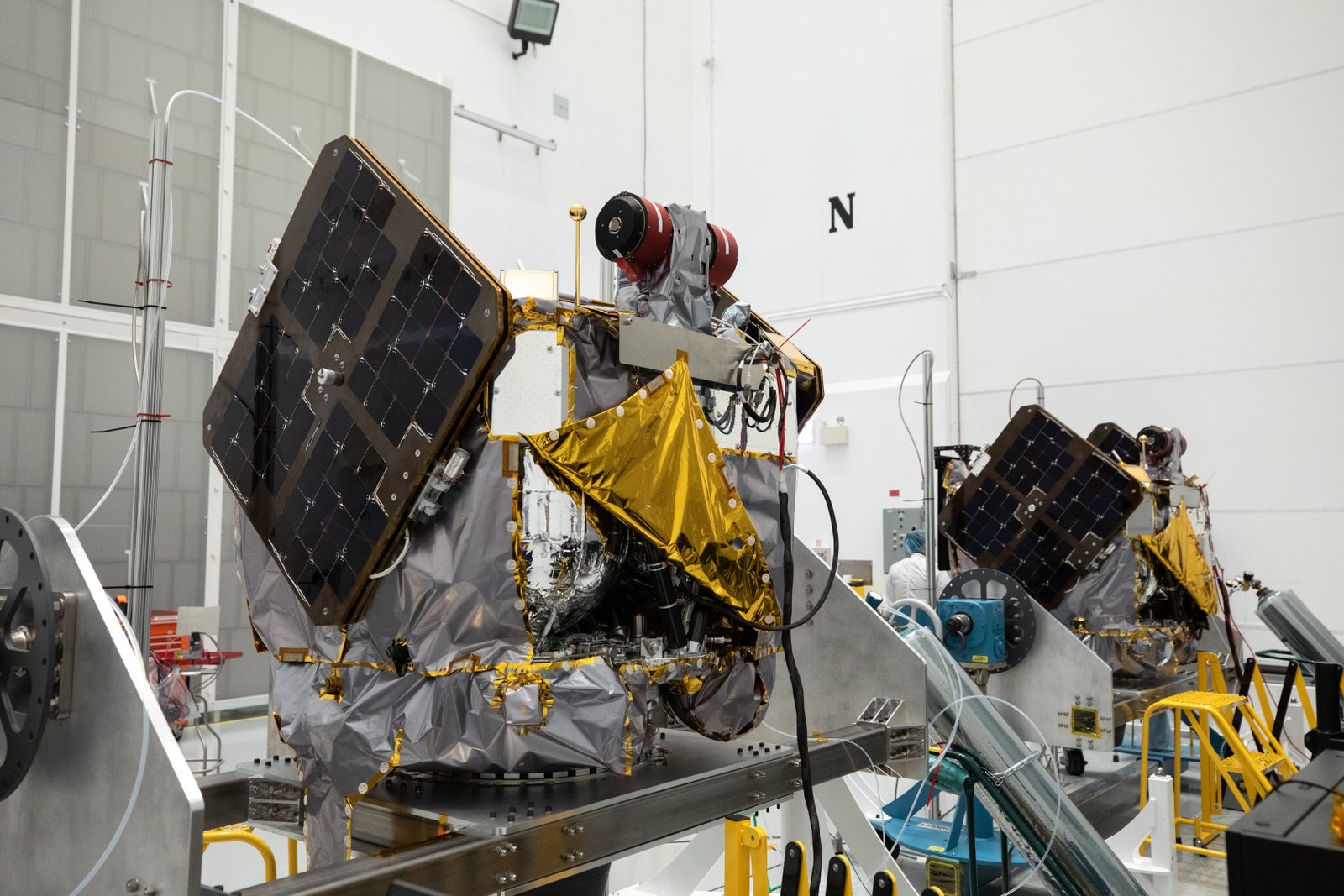
Because the two planets sat on opposite sides of the solar system during the November 2025 launch, mission navigators routed the Rocket Lab-built probes into a kidney-bean-shaped loiter loop around the Earth-Sun Lagrange point 2. That yearlong detour roughly a million miles away positioned both vehicles to dive back past Earth just as the planetary alignment window opened.
Executing the First Mars-Bound Oberth Maneuver
During closest approach, each probe will pass between 600 and 1,100 miles above Earth’s surface, flying higher than most low-Earth-orbit satellites. While diving through that gravitational well over southern Australia, each vehicle will ignite its main thruster for approximately nine minutes in a powered flyby known in astrodynamics as an Oberth maneuver.
The first of the twin ESCAPADE spacecraft will initiate its trans-Mars injection burn at 4:51 a.m. EST on Saturday, November 7, followed by its companion at 5:51 a.m. EST on Monday, November 9. Firing the engines at peak gravitational velocity will add more than 1,000 miles per hour to each probe’s interplanetary speed.
That thrust will accelerate the vehicles from roughly 6.3 miles per second to 6.7 miles per second, equivalent to jumping from Mach 30 to Mach 31, fast enough to cross from Washington to San Francisco in under seven minutes. Skywatchers in the western United States and southern Australia using backyard telescopes may spot the faint probes gliding slowly from east to west overhead in the hours before each burn.
Bonus Magnetotail Data and Formation Flying at Mars
The novel loiter loop around Lagrange point 2 already yielded unexpected scientific returns before the Mars cruise even began. While looping far from home, the probes crossed a previously unexplored sector of Earth’s distant magnetotail and used cameras from Northern Arizona University on July 3, 2026, to capture visible and thermal infrared calibration portraits of Earth and the Moon from 363,250 miles away.
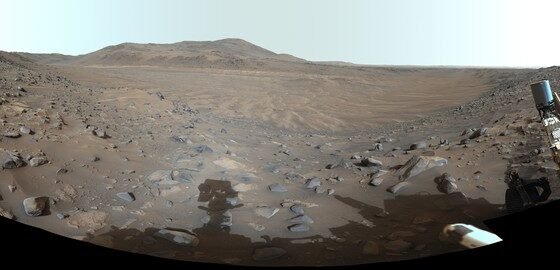
Following the November slingshots and subsequent trajectory correction maneuvers, the pair will spend 10 months cruising across deep space before arriving at Mars on September 7 and September 9, 2027. Led by principal investigator Rob Lillis at the University of California, Berkeley Space Sciences Laboratory with partners at Goddard Space Flight Center and Advanced Space, the probes will become the first dual spacecraft to fly in formation around Mars.
By taking simultaneous measurements from two orbital vantage points, the mission will track how million-mile-per-hour solar wind streams interact with the Martian environment and drive atmospheric escape. Readers following Science coverage can expect these tandem observations to reveal how space weather stripped away the planet’s ancient atmosphere.