By Noah Carter
Materials scientists at the University of Science and Technology of China have synthesized a zirconium-based chloride solid electrolyte that overcomes the prohibitive raw material costs of next-generation solid-state batteries. Formulated as lithium zirconium chloride, the compound slashes electrolyte material expenses by more than ninety percent while maintaining fast room-temperature ion transport and moisture resistance.
The Cost and Stability Bottleneck in Solid-State Batteries
All-solid-state lithium batteries promise to transform electric vehicles by replacing the volatile, flammable organic liquid electrolytes inside conventional lithium-ion cells with a non-flammable solid conductor. However, the two dominant solid electrolyte families—oxides and sulfides—each face severe manufacturing hurdles. Ceramic oxide electrolytes are brittle and require high-temperature sintering above 1,000 degrees Celsius, whereas sulfide electrolytes react with trace atmospheric moisture to release toxic hydrogen sulfide gas and degrade at high cathode voltages.
Lithium halide electrolytes, particularly chlorides, emerged as an attractive bridge because they combine high oxidative stability above 4 volts with soft mechanical deformability that allows cold-pressing at room temperature. Yet earlier flagship chloride conductors such as lithium yttrium chloride and lithium indium chloride rely on scarce rare-earth or noble-like metals with a +3 valence state. Industry targets indicate that solid electrolytes must cost less than 10 dollars per square meter to compete commercially, whereas a 50-micrometer layer of lithium yttrium chloride costs roughly 23 dollars per square meter in raw materials alone—and indium or scandium versions cost hundreds to thousands of dollars.
Replacing Scarce Rare Metals with Abundant Zirconium
Led by Professor Ma Cheng, the research team broke away from trivalent rare-earth metals by introducing tetravalent zirconium into the chloride crystal lattice to create Li2ZrCl6. Because zirconium is abundant in the Earth’s crust, its precursor salt, zirconium tetrachloride, costs a tiny fraction of indium, scandium, or yttrium chlorides when purchased at industrial metric-ton scale. At a standard 50-micrometer separator thickness, the raw material cost of Li2ZrCl6 drops to just 1.38 dollars per square meter, well below the 10-dollar commercial threshold required for mass-market electric cars.
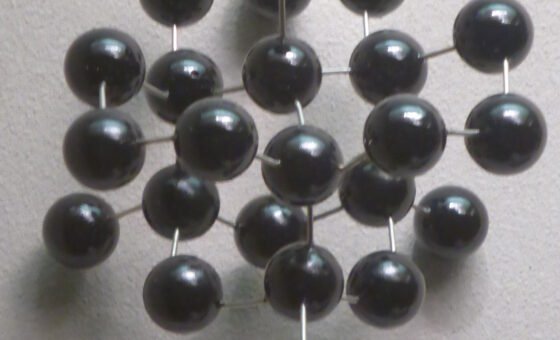
Synthesized through high-energy planetary ball milling of stoichiometric lithium chloride and zirconium tetrachloride, the as-milled material forms a metastable hexagonal crystal phase with non-periodic lattice defects that open low-barrier pathways for lithium ions. At 25 degrees Celsius, cold-pressed pellets of Li2ZrCl6 achieve a high room-temperature ionic conductivity of 0.81 millisiemens per centimeter alongside negligible electronic conductivity. Because the chloride powder is naturally soft and deformable, simple cold pressing achieves over ninety percent theoretical density without energy-intensive high-temperature sintering.
Humidity Tolerance and High-Voltage Cathode Cycling
In factory assembly environments, most sulfide and chloride electrolytes require ultra-dry rooms with dew points below minus 40 degrees Celsius to prevent rapid hydrolysis and structural degradation. In contrast, Li2ZrCl6 exhibits remarkable humidity tolerance, showing zero moisture uptake, phase decomposition, or conductivity loss even after prolonged exposure to an atmosphere with five percent relative humidity. This chemical resilience dramatically lowers climate-control energy costs and simplifies powder handling inside battery gigafactories.
When paired directly with uncoated, single-crystal high-nickel NMC811 cathodes operating above 4 volts, test cells using the Li2ZrCl6 electrolyte maintained a stable specific capacity of 150 milliampere-hours per gram across 200 charge-discharge cycles at room temperature. Ongoing innovations in battery storage and electric mobility are now refining aliovalent doping and oxychloride variants of this zirconium framework to bring safe, affordable solid-state packs into mass production.