By Ethan Brooks
Satellite communications startup Northwood Space has closed a $375 million Series C equity round, valuing the California-based company at $2 billion. The Northwood Space Series C funding will accelerate mass production of phased-array ground antennas and software-defined networking systems designed to connect rapidly growing constellations in low-Earth orbit with terrestrial data centers.
Announced on November 2, 2026, the financing round was co-led by Andreessen Horowitz and DFJ Growth, with additional participation from Washington Harbour Partners, Alpine Space Ventures, Stepstone, and In-Q-Tel. Alongside the equity investment, the company secured a multi-year credit facility from HSBC Innovation Banking to support manufacturing expansion and global site deployments. The latest capital injection brings Northwood Space’s total funding to more than $500 million since its founding in 2022 by Chief Executive Officer Bridgit Mendler and Chief Technology Officer Griffin Cleverly.
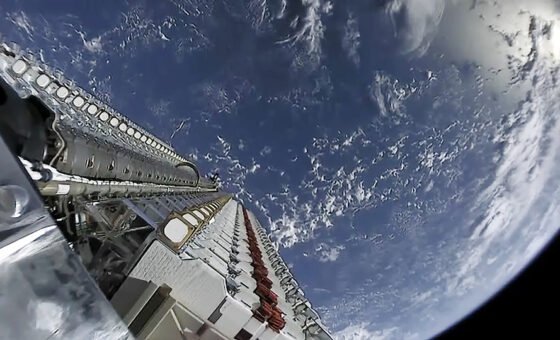
The Technology industry has dramatically lowered the cost of launching spacecraft into orbit, yet the ground infrastructure responsible for receiving and transmitting satellite telemetry has lagged behind. While thousands of commercial and defense satellites now circle Earth, many operators still rely on legacy mechanical parabolic dishes that can only track one spacecraft at a time. Northwood Space addresses this bottleneck by building compact, multi-beam phased-array ground terminals capable of communicating with multiple satellites simultaneously across diverse orbital planes.
Replacing Legacy Dishes With Phased-Array Ground Networks
Traditional satellite ground stations require months of civil engineering, custom radio frequency permitting, and mechanical calibration before they can process orbital data streams. In contrast, Northwood’s modular ground architecture uses flat-panel antenna tiles arranged in portable arrays that can be deployed rapidly and steered electronically without moving mechanical parts. Combined with cloud-managed routing software, these ground nodes dynamically allocate bandwidth across passing satellites, reducing latency and preventing dropped downlinks during peak orbital congestion.
Demand for resilient ground links has surged across both commercial Earth observation providers and national security agencies. Prior to the Northwood Space Series C round, the company raised a $100 million Series B in January 2026 and won a three-year, $49.8 million contract to modernize elements of the United States Space Force Satellite Control Network. Fulfilling those defense and commercial commitments requires expanding high-volume hardware production while securing geographically diverse antenna host sites across multiple continents and latitude zones.
Scaling Production and Global Telemetry Capacity
With fresh equity and debt financing in place, Northwood Space plans to expand its engineering and manufacturing workforce, enlarge its Torrance production footprint, and accelerate international ground station installations. By owning and operating its global antenna network while offering ground-station-as-a-service capacity, the company allows satellite fleet operators to purchase downlink minutes on demand rather than building proprietary ground hardware from scratch. This shared utility model significantly lowers upfront capital expenditure for emerging aerospace startups launching specialized sensor constellations.
As orbital traffic continues to multiply over the next several years, reliable space-to-ground bandwidth is becoming just as critical as rocket launch capacity. Industry analysts note that next-generation satellite applications—including real-time climate monitoring, autonomous maritime tracking, defense reconnaissance, and orbital edge computing—depend on continuous, high-throughput telemetry links. Northwood Space’s rapid valuation growth highlights strong investor confidence that modernizing terrestrial ground infrastructure is essential to unlocking the full commercial potential of the global space economy.