By Sophia Reed
Planetary scientists have confirmed that Mars meteorite Teghaza 001, a rose-colored stone recovered from a salt plain in Mali in 2022, formed more than 4.1 billion years ago. Detailed in a study published in Science in late October 2026, the nearly 2-pound specimen ranks among the three oldest Martian rocks ever discovered on Earth.
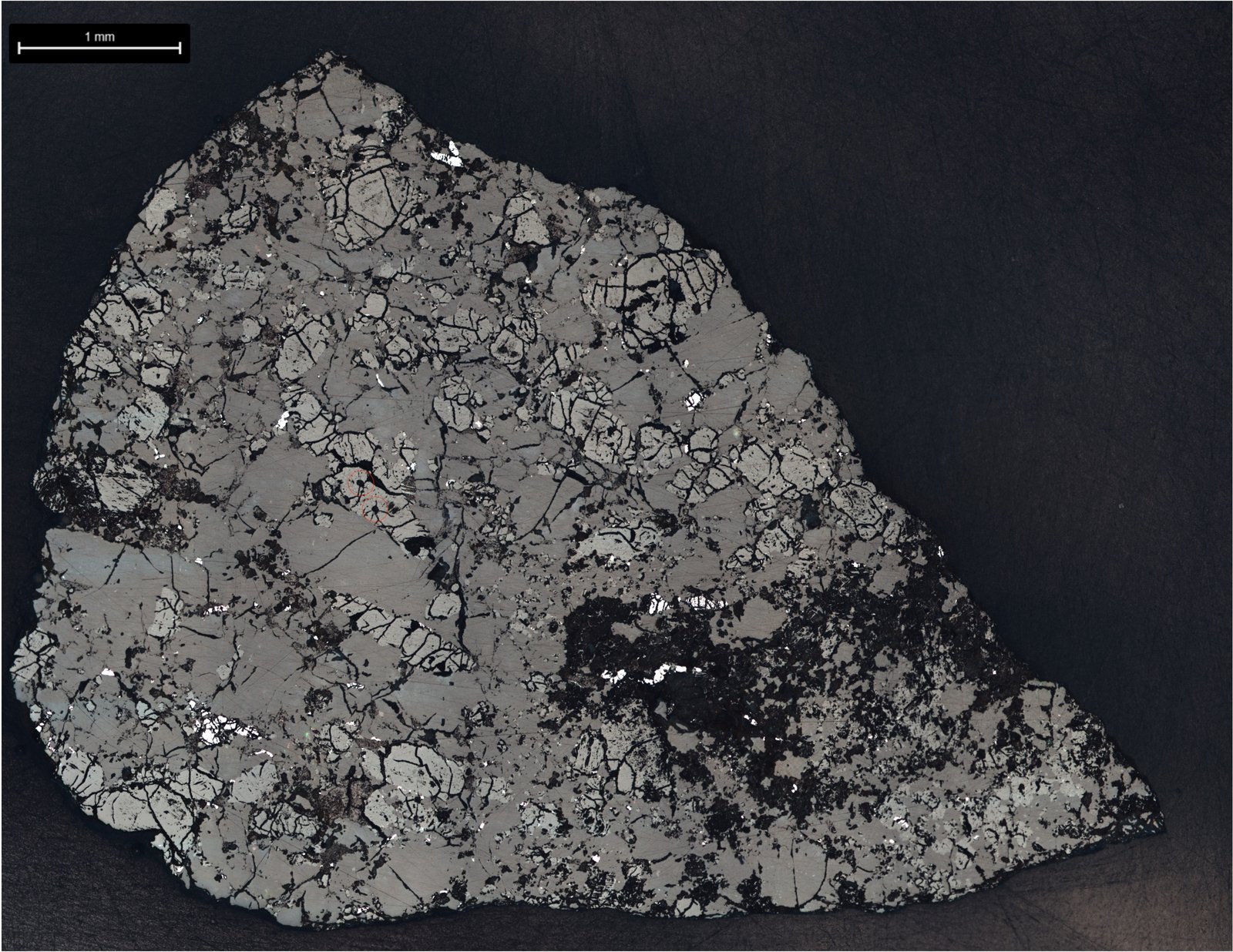
Weighing approximately 800 grams, the specimen is one of roughly 435 documented meteorites blasted off the Red Planet by ancient asteroid impacts. Lead author Yang Liu of the Jet Propulsion Laboratory in Southern California noted that reviewers described the rock as a geological Rosetta Stone for understanding early planetary crust formation.
Unlike the other two ultra-ancient Martian specimens—ALH84001, which consists almost entirely of a single mineral, and the 2.1-billion-year-old volcanic breccia nicknamed Black Beauty—this sample preserves a diverse mix of igneous minerals. Its chemical composition closely matches orbital measurements of Mars’ heavily cratered southern highlands, providing researchers with their first direct crustal sample from that region.
Non-Destructive Age Dating and Mineral Clues
Initial oxygen isotope testing at the University of New Mexico confirmed the rock’s Martian origin and classified it as a shergottite, the most common category of Martian meteorite. However, closer inspection revealed unusual textures, shocked plagioclase from impact pressure, iron-titanium oxides, pyroxene, and microscopic zircon crystals that lock in formation timestamps.
To determine the rock’s precise age without destroying the rare material, co-author Francois Tissot of Caltech applied a novel in-situ rubidium-strontium dating technique. Rather than dissolving a bulk rock chunk in acid, the team analyzed individual mineral grains on a polished slice smaller than a fingernail.
The laboratory analysis uncovered several defining geological characteristics:
- The igneous minerals crystallized from cooling magma more than 4.1 billion years ago during Mars’ earliest crustal epoch.
- Subsurface liquid water chemically altered the rock around 4.1 billion years ago, leaving fine-grained carbonate, sulfate, and clay signatures.
- Distinctive mineral ratios match 13 candidate source regions mapped by the Mars Reconnaissance Orbiter across the southern highlands.
Evidence of an Active Early Martian Water Cycle
Second author Lee Saper, who conducted the research at the Jet Propulsion Laboratory before joining the Ames Research Center in Silicon Valley, explained that the sample records both water-rock interactions and potential isotopic imprints of the ancient Martian atmosphere as it lost water to space. Those findings complement an earlier June 2026 paper in Science Advances that measured the rock’s water content.
Scientists verify Martian meteorites by matching trapped chemical and isotopic signatures against baseline measurements collected on the Martian surface by the Viking landers and the Curiosity and Perseverance rovers. In this specimen, reflected-light mineral maps helped researchers pinpoint unaltered volcanic grains alongside secondary minerals formed during ancient aqueous episodes.
Preserving the rest of the 800-gram stone intact allows laboratories around the world to conduct additional micro-scale analyses without depleting the specimen. Together, the geochemical evidence points toward a far more dynamic hydrological cycle on early Mars than previously documented in shergottite samples. Readers tracking planetary discoveries in our Top News coverage can expect further insights as researchers apply non-destructive dating methods to future returned samples.